Python Programming
Build the programming foundation for data work.
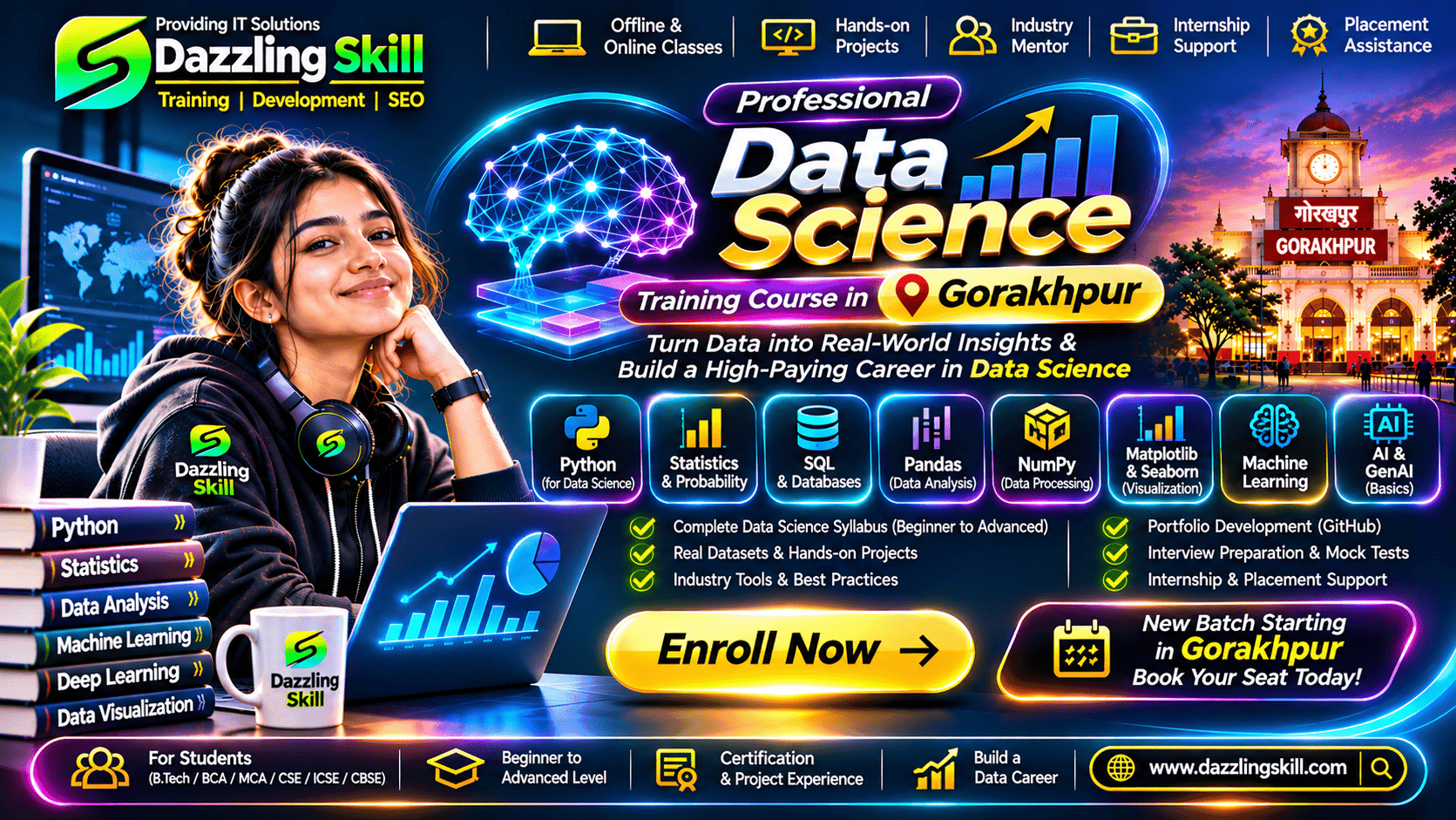
Learn how to collect, clean, analyse and interpret data. Build your foundation in Python, statistics, data visualisation, SQL and Machine Learning. Explore practical projects that connect data analysis with real-world problem solving.
15
Learning Modules
Python
Programming
Machine Learning
Predictive Models
Projects
Practical Learning
Understand data. Discover insights.
Learn Data Science at Dazzling Skill through a structured, practical learning roadmap. Start with Python programming, statistics and data handling. Progress into NumPy, Pandas, SQL, data cleaning, exploratory analysis, visualisation, Power BI and Machine Learning. Understand how to train and evaluate models and apply your knowledge through portfolio-oriented projects.
Build the programming foundation for data work.
Clean, transform and analyse datasets.
Communicate findings with charts and dashboards.
Explore prediction and pattern recognition.
Course coverage, fees, timings and availability are subject to confirmation with Dazzling Skill.
Progress from Python and statistics to data analysis, visualisation, machine learning and practical applications.
01–03
Foundations
04–06
Data Handling
07–09
Analytics
10–14
AI & ML
15
Projects
Understand Data Science, its applications and the complete process of converting raw data into useful insights.
Build a strong Python programming foundation for data analysis, automation and machine learning.
Learn the mathematical and statistical concepts used to understand datasets and build reliable models.
Use NumPy to perform fast numerical calculations and work efficiently with multidimensional data.
Learn to load, inspect, clean, transform and analyse structured datasets using Pandas.
Discover patterns, identify data quality problems and explore datasets before building analytical models.
Retrieve and analyse data from relational databases using SQL queries and database concepts.
Present analytical findings through meaningful charts, graphs and interactive reports.
Translate data into business insights using KPIs, reporting and analytical thinking.
Understand machine learning workflows and train models for prediction and pattern recognition.
Measure model performance, compare algorithms and understand how to improve predictions.
Explore techniques for discovering hidden patterns and grouping similar records.
Understand neural networks and explore the foundations of deep learning and modern AI applications.
Understand how to organise analytical projects and make trained models accessible to applications.
Apply the complete Data Science workflow to practical datasets and portfolio-oriented projects.
Module hours are indicative learning estimates, not a guaranteed class schedule or total course duration. The depth of mathematics, deep learning, model deployment and projects may be adjusted according to the selected batch and learning plan.
Data Science combines programming, statistics, mathematics and analytical techniques to extract meaningful information from data. It helps organisations understand past performance, discover patterns, make informed decisions and develop predictive models. A Data Science workflow can involve collecting data, cleaning it, exploring patterns, building models and communicating results.
Explore transaction patterns, risk and fraud detection concepts.
Analyse healthcare datasets and understand predictive modelling applications.
Study customer behaviour, product trends and recommendation concepts.
Understand campaign performance, customer segments and conversion trends.
Explore quality data, process patterns and predictive maintenance concepts.
Create reports and dashboards to support data-driven decisions.
Develop a structured understanding of data processing, analysis, visualisation and machine learning through practical exercises.
Build programming foundations and use Python for practical data analysis.
Work with datasets to clean, explore and communicate useful insights.
Understand the concepts behind analytical methods and ML models.
Explore algorithms, model training and performance evaluation.
Present findings through charts, reports and dashboard exercises.
Apply concepts through practical project-based learning.
Explore the programming languages, libraries, databases and visualisation tools used in common Data Science workflows.
Tool versions and installation methods may vary. Specific tools depend on the selected learning modules.
Learn with purpose
Data Science is best learned by working with data, asking meaningful questions and testing your findings. Follow a structured learning path from Python and statistics to analytics and machine learning. Focus on understanding the process behind the results, not just running code or copying models.
Develop practical skills in Python, analytics and machine learning.
Explore data-driven problem solving alongside academic learning.
Build a foundation for exploring data-focused technology roles.
Extend Python knowledge into data analysis and machine learning.
Learn data cleaning, SQL, visualisation and reporting.
Explore analytical techniques and data-driven decision making.
Basic computer knowledge is recommended. Familiarity with mathematics and logical problem-solving is helpful. Python programming starts from the fundamentals, so advanced programming knowledge is not required to begin the foundation modules.
Discuss your programming background, learning goals and preferred schedule before selecting a batch.
Explore classroom learning options in Gorakhpur.
Ask about online learning availability and the current class format.
Contact Dazzling Skill to confirm the current Data Science course fees, monthly payment options, batch timings, schedules, course coverage and admission availability. The actual duration depends on your starting level and selected learning plan.
Actual proficiency depends on practice, project work and the topics covered in your selected learning plan.
Explore your possibilities
Data Science skills can support several analytical and technology career paths. Each role may require additional tools, domain knowledge, practical experience and specialised training.
SQL, Excel, Python, data cleaning, visualisation and reporting
Python, statistics, EDA, machine learning and model evaluation
Power BI, SQL, KPIs, dashboards and business reporting
Python, ML algorithms, model evaluation and software engineering
Python, data processing, APIs and application development
Machine learning foundations, neural networks and AI concepts
Career opportunities are not guaranteed and depend on your skills, portfolio, experience and market conditions. Some roles require advanced mathematics, software engineering or specialised ML knowledge.
Apply your knowledge through different types of data analysis and machine learning exercises. These are suggested project ideas; confirm the guided projects included in your batch.
Analyse sales records to discover revenue trends, top-performing products and monthly business performance.
Skills Applied
Python, Pandas, NumPy and Matplotlib
Explore customer records and create an interactive dashboard to communicate important business KPIs.
Skills Applied
SQL, Power BI and Data Visualisation
Prepare housing data, identify useful features and train a regression model to estimate property prices.
Skills Applied
Pandas, EDA, Scikit-learn and Regression
Analyse customer behaviour and build a classification model to identify customers at risk of leaving.
Skills Applied
Data Cleaning, Classification and Model Evaluation
Group customers according to their behaviour and purchasing patterns using clustering techniques.
Skills Applied
EDA, Feature Scaling and K-means
Build a complete workflow from data preparation and model training to a simple prediction interface.
Skills Applied
Python, Scikit-learn, Streamlit and Model Deployment
Continue learning with official documentation, Python references, machine learning guides and data science practice platforms.
Learn Python syntax, modules and programming fundamentals.
Explore ResourceExplore numerical computing and multidimensional arrays.
Explore ResourceLearn DataFrames, data cleaning and data manipulation.
Explore ResourceCreate charts and visualisations using Python.
Explore ResourceExplore statistical data visualisation techniques.
Explore ResourceExplore machine learning algorithms and model evaluation.
Explore ResourceLearn deep learning and neural network development.
Explore ResourceExplore dashboards, reports and business intelligence.
Explore ResourceLearn relational databases and SQL fundamentals.
Explore ResourceExplore datasets, notebooks and data science competitions.
Explore ResourceEverything you need to know
Find answers to common questions about Python, statistics, data analysis, SQL, Machine Learning, projects, learning options, fees and admission.
Data Science is an interdisciplinary field that uses programming, statistics, mathematics and analytical techniques to extract insights and knowledge from data.
Please contact the institute to verify current admission details, fees, batch schedules and course coverage.
Turn curiosity into practical skills
Learn Python, explore data, understand Machine Learning and build practical projects with Dazzling Skill in Gorakhpur.
DAZZLING SKILL · LEARN · ANALYSE · BUILD