✦ IT TRAINING|WEB & SOFTWARE DEVELOPMENTAdmissions Open 2027
Cloud Computing Course Training in Gorakhpur at Dazzling Skill
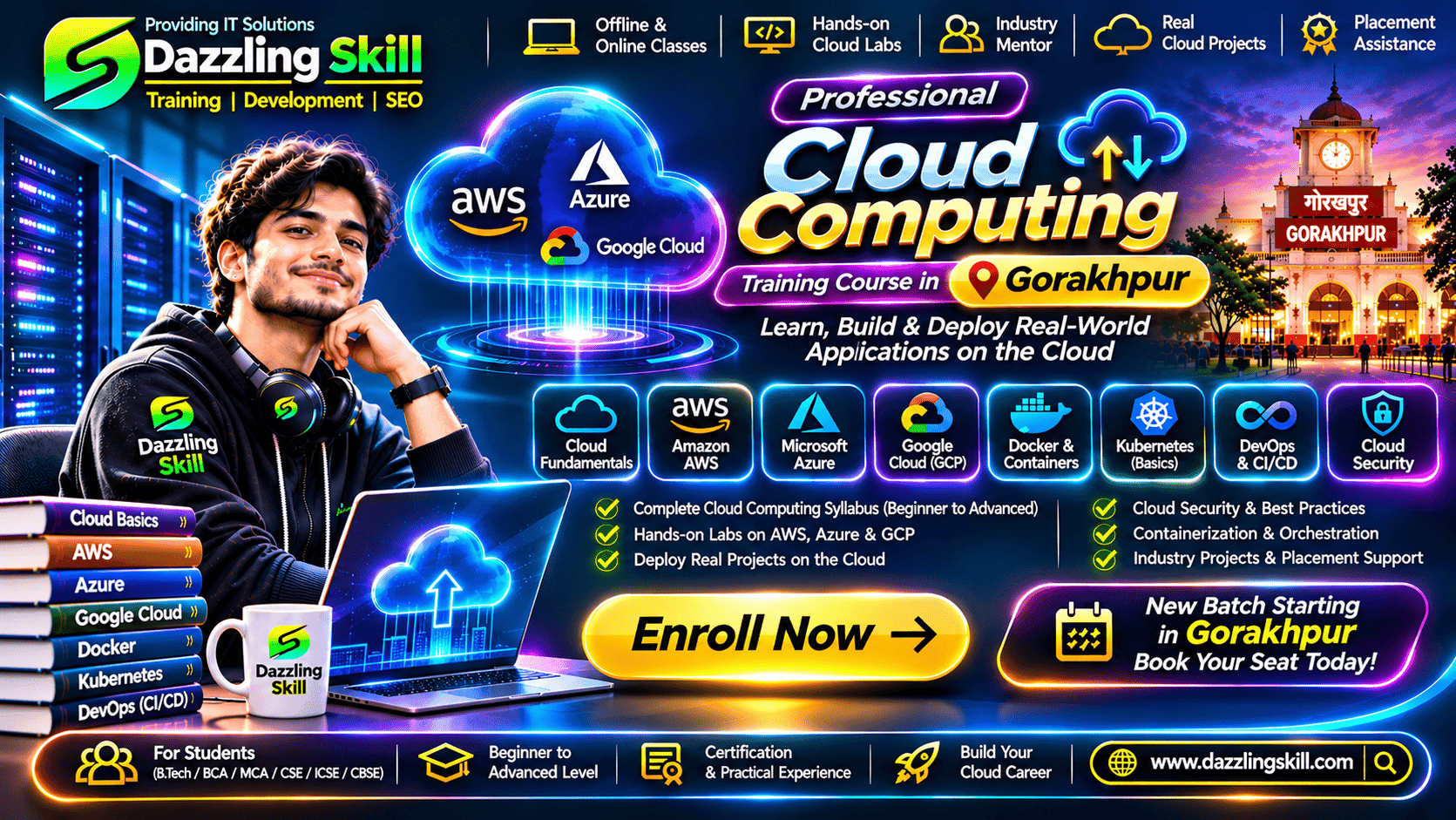
Professional Cloud Computing TrainingGorakhpurBeginner to Advanced

Build Your Future inCloud ComputingCourse & Training in Gorakhpur

AWS • Azure • Docker • Kubernetes • DevOps

Learn how modern applications run on the cloud. Explore cloud infrastructure, AWS, Microsoft Azure, Linux, networking, storage, Docker, Kubernetes, CI/CD, Infrastructure as Code and cloud security through a structured learning roadmap.

15

Learning Modules

AWS + Azure

Cloud Platforms

Docker + K8s

Container Technologies

Projects

Practical Learning

Understand. Build. Deploy.

Cloud Computing Course in Gorakhpur

The Cloud Computing learning roadmap at Dazzling Skill introduces you to modern cloud infrastructure and application deployment. Learn cloud fundamentals, AWS, Microsoft Azure, Linux, networking, storage, Docker, Kubernetes, DevOps workflows, CI/CD, Terraform and cloud security. Progress from foundational concepts to deployment-oriented exercises and practical project work.

Cloud Platforms

Explore AWS, Azure and cloud service models.
Cloud Infrastructure

Understand virtual machines, storage and networks.

Containers & DevOps

Explore Docker, Kubernetes and CI/CD workflows.

Cloud Security

Understand access control and secure configurations.

Course coverage, platform access, lab facilities, fees, timings and availability should be confirmed with Dazzling Skill before admission.

Structured learning roadmap

Complete Cloud Computing Course Syllabus

Start with cloud and networking fundamentals, progress through AWS and Azure, then explore containers, DevOps, automation, monitoring and deployment projects.

01–04

Foundations

05–08

AWS & Azure

09–11

Security & Containers

12–14

DevOps & Automation

15

Projects

01

01. Introduction to Cloud Computing

Understand cloud computing, its architecture, service models and how organisations use cloud platforms.

3–4 Hours
  • What is Cloud Computing?
  • Evolution of cloud technology
  • Traditional IT infrastructure vs cloud
  • Benefits and limitations of cloud computing
  • Public, private and hybrid cloud
  • Community cloud overview
  • Infrastructure as a Service (IaaS)
  • Platform as a Service (PaaS)
  • Software as a Service (SaaS)
  • Cloud deployment models
  • Scalability and elasticity
  • High availability and fault tolerance
  • Cloud regions and availability zones
  • Cloud computing career landscape
02

02. Networking Fundamentals for Cloud

Build the networking knowledge required to understand cloud infrastructure, virtual networks and connectivity.

5–7 Hours
  • Computer networking fundamentals
  • LAN, WAN and internet architecture
  • OSI and TCP/IP models
  • IPv4 and IPv6 fundamentals
  • Public and private IP addresses
  • Subnetting basics
  • DNS and DHCP
  • TCP and UDP
  • Common ports and protocols
  • HTTP and HTTPS
  • Routing and gateways
  • NAT and network address translation
  • Firewalls and network security groups
  • Load balancing fundamentals
  • Basic network troubleshooting
03

03. Linux & Operating System Fundamentals

Learn Linux administration concepts and command-line workflows commonly used to manage cloud servers.

5–7 Hours
  • Linux introduction and distributions
  • Linux installation and virtual machines
  • Linux directory structure
  • Terminal and shell fundamentals
  • File and directory management
  • Users and groups
  • File permissions and ownership
  • Process management
  • Package management
  • Service management
  • SSH and remote server access
  • Environment variables
  • Basic shell scripting
  • Linux logs and system monitoring
  • Linux server administration basics
04

04. Cloud Platforms & Account Fundamentals

Explore the major cloud providers, their consoles, account structures, billing concepts and service categories.

3–5 Hours
  • Introduction to AWS
  • Introduction to Microsoft Azure
  • Cloud provider service comparison
  • Cloud account and subscription concepts
  • Management console navigation
  • Regions and availability zones
  • Resource groups and organisation
  • Cloud billing fundamentals
  • Budgets and cost alerts
  • Free-tier awareness and limitations
  • Resource tagging
  • Cloud documentation and support
  • Responsible account management
05

05. Amazon Web Services (AWS) Fundamentals

Understand important AWS services used for computing, storage, networking, databases and access management.

6–8 Hours
  • AWS global infrastructure
  • AWS Management Console
  • IAM users, groups and roles
  • EC2 virtual servers
  • EC2 instance types and key pairs
  • Security groups
  • Elastic IP concepts
  • S3 object storage
  • S3 buckets and access permissions
  • EBS storage fundamentals
  • RDS database overview
  • VPC fundamentals
  • Subnets and route tables
  • Internet gateways
  • Load balancer overview
  • CloudWatch monitoring introduction
06

06. Microsoft Azure Fundamentals

Explore Microsoft Azure architecture and commonly used services for compute, storage, networking and identity.

6–8 Hours
  • Azure cloud architecture
  • Azure portal navigation
  • Subscriptions and resource groups
  • Azure regions and availability zones
  • Azure Virtual Machines
  • Azure VM sizing and configuration
  • Azure Storage accounts
  • Blob storage fundamentals
  • Azure Virtual Network
  • Subnets and network security groups
  • Azure Load Balancer overview
  • Azure App Service introduction
  • Azure SQL overview
  • Microsoft Entra ID fundamentals
  • Azure Monitor introduction
  • Azure cost management overview
07

07. Cloud Storage, Databases & Backup

Understand cloud data storage, managed databases, backup strategies and recovery planning.

4–6 Hours
  • Cloud storage fundamentals
  • Object, block and file storage
  • AWS S3 and Azure Blob concepts
  • Storage classes and lifecycle policies
  • Cloud database fundamentals
  • Relational database services
  • NoSQL database overview
  • Managed database concepts
  • Database connectivity
  • Backup and restore strategies
  • Snapshots and recovery points
  • Data replication concepts
  • Availability and durability
  • Data protection fundamentals
08

08. Cloud Networking & Infrastructure

Learn how cloud networks are designed and how virtual infrastructure components communicate securely.

5–7 Hours
  • Virtual Private Cloud (VPC)
  • Azure Virtual Network (VNet)
  • Subnets and CIDR notation
  • Route tables
  • Internet and NAT gateways
  • Network security groups
  • Security groups and firewall rules
  • Private and public connectivity
  • VPN connectivity concepts
  • VPC peering and network connectivity
  • Load balancing
  • DNS management
  • Network monitoring
  • High availability architecture
  • Basic infrastructure design
09

09. Cloud Identity, Security & Access Management

Understand how cloud accounts, identities, permissions and security controls help protect cloud resources.

4–6 Hours
  • Cloud security fundamentals
  • Shared responsibility model
  • Identity and Access Management
  • Users, groups and roles
  • Role-based access control
  • Principle of least privilege
  • Multi-factor authentication
  • Access keys and credential safety
  • Secrets management concepts
  • Encryption at rest and in transit
  • Cloud firewall fundamentals
  • Secure storage permissions
  • Security monitoring
  • Backup and recovery planning
  • Common cloud security misconfigurations
10

10. Virtualisation & Containerisation with Docker

Understand virtual machines and containers, then explore Docker workflows for packaging and running applications.

5–7 Hours
  • Virtualisation fundamentals
  • Virtual machines vs containers
  • Container architecture
  • Introduction to Docker
  • Docker installation and setup
  • Docker images and containers
  • Dockerfile fundamentals
  • Building custom images
  • Container lifecycle management
  • Port mapping
  • Volumes and persistent storage
  • Docker networking
  • Environment variables
  • Docker Compose fundamentals
  • Container registries
  • Container security basics
11

11. Kubernetes & Container Orchestration

Explore Kubernetes architecture and understand how containerised applications are deployed and managed.

5–7 Hours
  • Why container orchestration?
  • Introduction to Kubernetes
  • Kubernetes architecture
  • Control plane and worker nodes
  • Pods and deployments
  • Services and networking
  • Namespaces
  • ConfigMaps and Secrets concepts
  • ReplicaSets
  • Scaling applications
  • Rolling updates and rollbacks
  • Persistent volumes
  • Ingress fundamentals
  • Kubernetes dashboard and kubectl overview
  • Container orchestration use cases
12

12. DevOps, Git & CI/CD Fundamentals

Understand modern software delivery workflows and how code moves from development to deployment.

5–7 Hours
  • Introduction to DevOps
  • DevOps culture and lifecycle
  • Git fundamentals
  • GitHub repositories
  • Branching and merging
  • Pull requests and collaboration
  • Build and release concepts
  • Continuous Integration
  • Continuous Delivery and Deployment
  • CI/CD pipeline architecture
  • GitHub Actions introduction
  • Jenkins overview
  • Automated testing concepts
  • Environment variables and secrets
  • Deployment workflow
  • Pipeline monitoring and troubleshooting
13

13. Infrastructure as Code & Automation

Learn how infrastructure can be described, version-controlled and provisioned through automation.

4–6 Hours
  • Infrastructure as Code concepts
  • Manual vs automated infrastructure
  • Terraform introduction
  • Providers and resources
  • Terraform configuration files
  • Variables and outputs
  • Terraform plan and apply concepts
  • State file fundamentals
  • Reusable modules overview
  • Cloud resource provisioning concepts
  • Configuration management overview
  • Automation and scripting
  • Version control for infrastructure
  • Infrastructure change management
14

14. Cloud Monitoring, Reliability & Cost Optimisation

Understand how cloud environments are monitored, maintained and optimised for performance, reliability and cost.

4–6 Hours
  • Cloud monitoring fundamentals
  • Metrics, logs and traces
  • AWS CloudWatch overview
  • Azure Monitor overview
  • Alerts and notifications
  • Application health monitoring
  • Resource utilisation
  • Performance troubleshooting
  • High availability concepts
  • Disaster recovery fundamentals
  • Backup verification
  • Cloud cost estimation
  • Resource tagging and cost allocation
  • Rightsizing concepts
  • Unused resource identification
  • Reliability best practices
15

15. Practical Projects, Deployment & Career Preparation

Bring cloud concepts together through deployment exercises, infrastructure planning and project documentation.

Variable
  • Deploying a sample web application
  • Hosting static website content
  • Configuring cloud storage
  • Setting up a virtual server
  • Connecting application and database
  • Configuring cloud networking
  • Containerising a sample application
  • Running a containerised application
  • Understanding a CI/CD workflow
  • Infrastructure automation exercise
  • Cloud monitoring exercise
  • Security and access review
  • Cost estimation exercise
  • Project documentation
  • GitHub portfolio preparation
  • Resume and interview preparation

Important Cloud Account & Cost Guidelines

Cloud providers may charge for services, storage, virtual machines, networking and data transfer. Practical exercises should use suitable account permissions, budgets and cost controls. Do not leave paid resources running unnecessarily. Module hours are indicative estimates, not a guaranteed class schedule or total course duration.

What Is Cloud Computing?

Cloud Computing is a way of accessing computing resources such as servers, databases, storage, networking and software through cloud platforms. Instead of purchasing and maintaining every infrastructure component locally, organisations can provision resources from cloud providers according to their requirements.

Major Areas of Cloud Computing

Cloud Infrastructure

Understand virtual servers, networking, storage and computing resources.

Cloud Storage & Databases

Explore object storage, managed databases, backup and recovery.

Cloud Networking

Learn virtual networks, subnets, routing, gateways and connectivity.

Containers & Kubernetes

Understand application containers and orchestration concepts.

DevOps & CI/CD

Explore automated software build, testing and deployment workflows.

Cloud Security

Understand identity, permissions, encryption and secure configuration.

Cloud Computing Course Learning Objectives

Develop a structured understanding of cloud platforms and learn how infrastructure, applications and deployment workflows operate.

Understand cloud computing concepts and architecture.
Compare public, private and hybrid cloud models.
Understand IaaS, PaaS and SaaS service models.
Build networking foundations for cloud environments.
Work with Linux and command-line fundamentals.
Understand AWS and Microsoft Azure service categories.
Explore virtual machines and cloud compute services.
Understand cloud storage and managed databases.
Learn VPC, VNet, subnets and cloud networking.
Understand identity and access management.
Explore cloud security and shared responsibility.
Learn Docker and containerisation fundamentals.
Understand Kubernetes and orchestration concepts.
Explore Git and CI/CD workflows.
Understand Infrastructure as Code with Terraform.
Explore cloud monitoring and cost optimisation.
Deploy sample applications in suitable environments.
Document cloud projects and build a learning portfolio.

Cloud Computing Training Features

☁️

Cloud Fundamentals

Understand cloud architecture, deployment models and service models step by step.

🌐

AWS & Azure Concepts

Explore services used for cloud computing, storage, networking and application hosting.

🐧

Linux & Networking

Build the operating system and networking foundations required for cloud work.

🐳

Docker & Containers

Understand how applications are packaged and run in container environments.

⚙️

Kubernetes Fundamentals

Explore container orchestration, deployments, services and scaling concepts.

🔄

DevOps & CI/CD

Understand source control, automated workflows and application delivery.

🔐

Cloud Security

Learn identity, access control, shared responsibility and secure configuration.

🚀

Project-Oriented Learning

Apply concepts through deployment exercises and cloud project documentation.

Cloud Computing Tools & Technologies

Explore technologies commonly used for cloud infrastructure, application deployment, containerisation, automation and monitoring.

☁️

Amazon Web Services

🔷

Microsoft Azure

🐧

Linux

🖥️

AWS EC2

🗄️

AWS S3

💻

Azure Virtual Machines

🐳

Docker

⚙️

Kubernetes

🏗️

Terraform

🐙

Git & GitHub

🔄

GitHub Actions

🛠️

Jenkins

📊

AWS CloudWatch

📈

Azure Monitor

🖥️

VirtualBox

💻

VS Code

Tool versions, cloud account access and practical coverage may vary according to the selected batch. Some cloud services may incur separate usage charges.

Learn. Build. Deploy.

Why Choose Dazzling Skill?

Cloud computing requires more than knowing service names. Understand how servers, networks, databases and applications work together. Build a foundation in cloud platforms, explore deployment workflows and learn how containers, automation and security fit into modern infrastructure.

Structured cloud computing roadmap
AWS and Azure service fundamentals
Linux and networking foundations
Cloud infrastructure concepts
Docker and Kubernetes fundamentals
DevOps and CI/CD introduction
Infrastructure as Code concepts
Cloud security awareness
Project and portfolio guidance

Who Should Join This Cloud Computing Course?

🎓

BCA & MCA Students

Build practical cloud computing knowledge alongside your academic studies.

💻

B.Tech & Computer Science Students

Explore cloud infrastructure, deployment, containers and DevOps concepts.

🌱

Beginners

Start with cloud fundamentals, networking and Linux before advanced topics.

👨‍💻

Web Developers

Understand how applications, databases and websites can be deployed on cloud platforms.

🖥️

IT & System Administrators

Explore virtual servers, cloud networking, monitoring and infrastructure.

🚀

Aspiring DevOps Engineers

Build foundations in containers, CI/CD, automation and cloud infrastructure.

Recommended Prerequisites

Basic computer knowledge is recommended. Familiarity with operating systems, networking and programming can make the learning process easier. Beginners can start with the foundational modules. A laptop suitable for the selected practical tools is useful.

Flexible Learning Options

Plan Your Cloud Computing Learning Journey

Discuss your current skill level, preferred schedule and practical learning requirements with Dazzling Skill before selecting a batch.

Classroom Training🏫

Offline Learning

Enquire about available classroom training schedules in Gorakhpur.

  • Structured cloud computing roadmap
  • Instructor-led concept explanations
  • AWS and Azure fundamentals
  • Linux and networking concepts
  • Cloud deployment exercises
  • Project-oriented learning
Online Learning🌐

Online Learning

Ask about online learning and practical cloud lab arrangements from your location.

  • Structured cloud computing roadmap
  • AWS and Azure service concepts
  • Networking and Linux fundamentals
  • Docker and DevOps concepts
  • Deployment-oriented exercises
  • Project and portfolio guidance
ℹ️

Admission & Fee Information

Contact Dazzling Skill to confirm current Cloud Computing course fees, monthly payment options, batch timings, platform access, practical lab availability and admission details. Cloud provider usage charges, where applicable, should also be clarified before practical work begins.

What Will You Learn?

Understand cloud computing fundamentals.
Compare AWS and Microsoft Azure services.
Understand IaaS, PaaS and SaaS.
Learn networking and cloud connectivity.
Work with Linux and command-line tools.
Understand virtual machines and cloud servers.
Explore cloud storage and databases.
Understand VPC, VNet and subnets.
Learn cloud identity and access management.
Understand cloud security fundamentals.
Explore Docker and containerisation.
Understand Kubernetes architecture.
Learn Git and GitHub workflows.
Explore CI/CD pipeline concepts.
Understand Terraform and Infrastructure as Code.
Explore cloud monitoring and logging.
Understand cost and resource optimisation.
Build deployment-oriented cloud projects.

Actual proficiency depends on practice, project work and the topics covered in your selected learning plan.

Explore your possibilities

Cloud Computing Skills & Career Paths

Cloud computing knowledge can support different infrastructure, cloud operations and DevOps career paths. Each role may require additional practical experience, role-specific skills and certifications.

Cloud Support Associate

Cloud service fundamentals, troubleshooting, account and resource support.

Cloud Engineer

Virtual infrastructure, networking, storage, deployment and monitoring.

AWS Cloud Associate

Foundational AWS services, access management and cloud architecture concepts.

Azure Administrator Path

Azure resources, subscriptions, identity, networking and monitoring.

DevOps Engineer

CI/CD, source control, automation, containers and deployment workflows.

Cloud Operations Associate

Cloud monitoring, resource management, reliability and operational support.

Junior Site Reliability Engineer

Monitoring, availability, automation and reliability fundamentals.

Cloud Security Associate

Identity, permissions, secure configuration and cloud security monitoring.

Career opportunities are not guaranteed and depend on your skills, practical experience, portfolio, additional qualifications and market conditions.

Practical Cloud Computing Projects

Apply your knowledge through cloud deployment, infrastructure and automation exercises. These are suggested project ideas; confirm the guided projects included in your batch.

🌐Beginner

Deploy a Static Website on Cloud

Understand how static website files can be hosted using cloud storage and related hosting services.

Skills Applied

Cloud storage, hosting, permissions and deployment

🖥️Beginner

Linux Cloud Virtual Server

Explore the process of provisioning a Linux virtual machine and understanding secure remote access.

Skills Applied

EC2 or Azure VM concepts, Linux and SSH

🗄️Beginner

Cloud Storage & Backup Plan

Create a sample storage design and document access, backup and recovery considerations.

Skills Applied

S3, Azure Blob concepts, access control and backup

🚀Intermediate

Deploy a Web Application

Plan and deploy a sample application using a suitable cloud compute or application hosting service.

Skills Applied

Cloud compute, application deployment and networking

🐳Intermediate

Dockerise an Application

Package a sample application into a Docker image and understand container execution and configuration.

Skills Applied

Dockerfile, images, containers and Docker Compose

🔄Intermediate

CI/CD Pipeline Demonstration

Explore a basic automated build and deployment workflow using a source-code repository.

Skills Applied

Git, GitHub Actions or Jenkins concepts

🌍Advanced

Cloud Network Architecture

Prepare a cloud network design with subnets, routing, access controls and a documented architecture.

Skills Applied

VPC or VNet, subnets, routing and security groups

⚙️Advanced

Infrastructure as Code Exercise

Explore infrastructure provisioning using a version-controlled Terraform configuration.

Skills Applied

Terraform, cloud resources and automation

📊Advanced

Cloud Monitoring & Cost Review

Review sample monitoring metrics and prepare recommendations for reliability and cost optimisation.

Skills Applied

Cloud monitoring, alerts, resource usage and cost concepts

Cloud Computing Learning Resources

Continue learning with official cloud platform documentation, container resources and infrastructure automation guides.

☁️
AWS

AWS Documentation

Explore official documentation, service guides and learning resources for Amazon Web Services.

Explore Resource
🎓
AWS Learning

AWS Skill Builder

Explore digital courses and learning paths from AWS.

Explore Resource
🔷
Microsoft Azure

Microsoft Learn – Azure

Learn Azure services, cloud concepts and Microsoft cloud technologies.

Explore Resource
🏗️
Cloud Architecture

Azure Architecture Center

Explore reference architectures, design guidance and cloud architecture patterns.

Explore Resource
🐳
Containers

Docker Documentation

Learn container fundamentals, Docker commands and application containerisation.

Explore Resource
⚙️
Orchestration

Kubernetes Documentation

Explore Kubernetes concepts, architecture and official learning tutorials.

Explore Resource
🧩
Infrastructure as Code

Terraform Documentation

Understand Infrastructure as Code and Terraform configuration.

Explore Resource
🔄
CI/CD

GitHub Actions Documentation

Explore automated workflows, CI/CD concepts and GitHub Actions.

Explore Resource
🐧
Linux

Linux Documentation

Explore Linux kernel documentation and foundational system concepts.

Explore Resource
🌐
Cloud Native

CNCF

Explore cloud-native technologies, projects and ecosystem resources.

Explore Resource

Everything you need to know

Cloud Computing Course FAQs

Find answers to common questions about AWS, Azure, Docker, Kubernetes, DevOps, practical projects, fees, career paths and admission.

Cloud Computing means using computing resources such as servers, storage, databases, networking and software over the internet instead of managing all infrastructure locally.

Please contact the institute to verify current admission details, fees, batch schedules, platform access, practical lab availability and certification terms.

Learn. Build. Deploy.

Ready to Start Your Cloud Computing Journey?

Explore AWS, Azure, cloud infrastructure, Docker, Kubernetes, DevOps and modern deployment concepts with Dazzling Skill in Gorakhpur.

DAZZLING SKILL · LEARN · BUILD · DEPLOY