✦ IT TRAINING|WEB & SOFTWARE DEVELOPMENTAdmissions Open 2027
C Programming Course and Training in Gorakhpur at Dazzling Skill
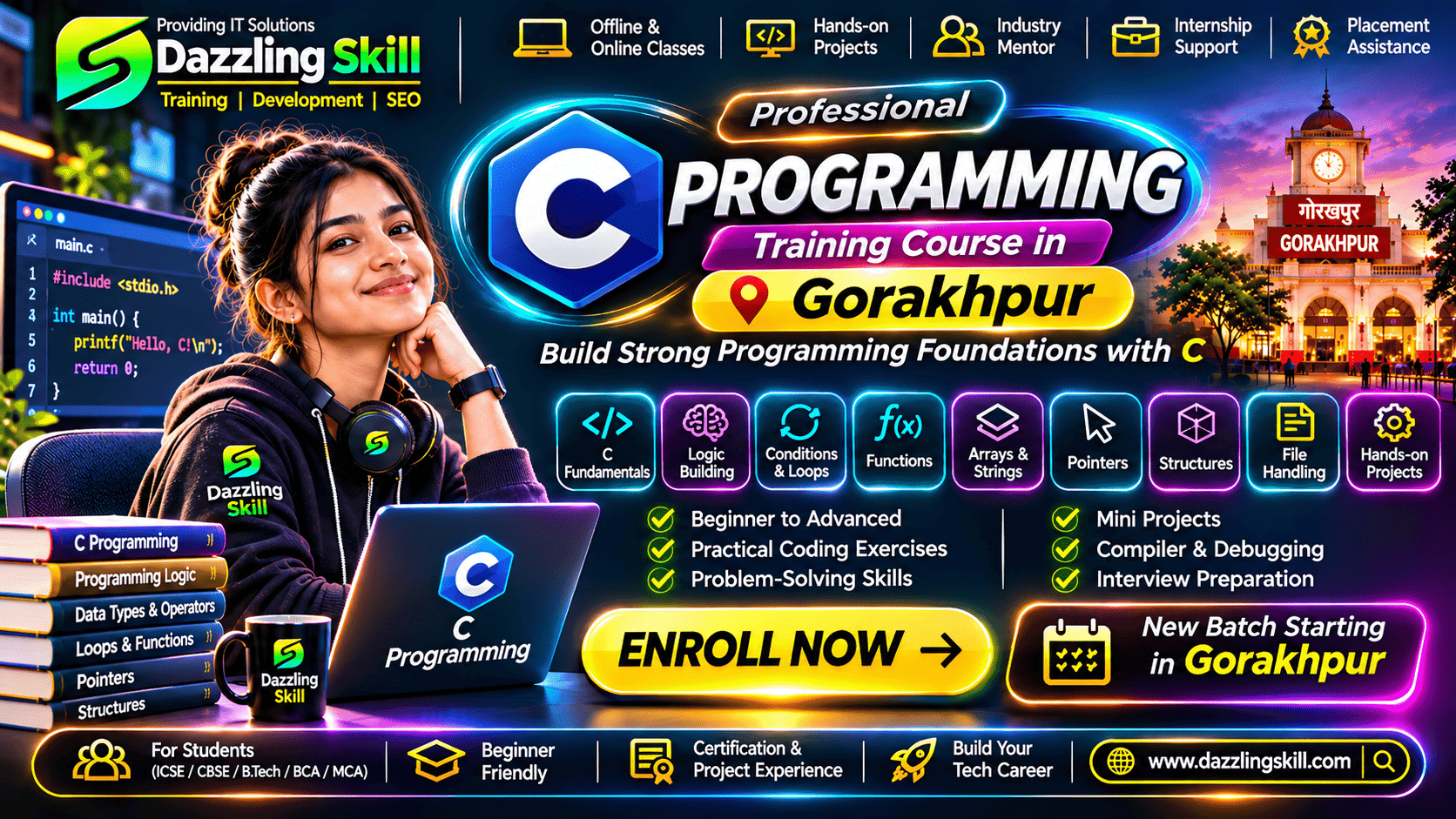
Professional C Programming TrainingGorakhpur

Build Your Programming Foundation WithC ProgrammingCourse & Training in Gorakhpur

Learn C programming from the fundamentals to functions, arrays, strings, pointers, structures and file handling. Develop programming logic, understand memory concepts and apply your knowledge through practical coding projects.

12

Learning Modules

C

Programming Language

100%

Logic Building Focus

Projects

Practical Learning

Start with the fundamentals

C Programming Course in Gorakhpur

Learn C programming at Dazzling Skill through a structured learning roadmap. Start with variables, data types and operators, understand conditions and loops, and progress to functions, arrays, strings, pointers, structures and file handling. Practise writing programs and develop a stronger understanding of programming logic.

C Fundamentals

Build a strong foundation in C syntax, data types and operators.
Logic Building

Practise conditions, loops, functions and problem-solving.

Pointers & Memory

Understand pointers, memory addresses and dynamic allocation.

Practical Projects

Apply C concepts through console-based programming exercises.

Course coverage, fees, timings and availability are subject to confirmation with Dazzling Skill.

Structured learning roadmap

Complete C Programming Syllabus

Explore the concepts, programming techniques and practical topics included in this C language learning outline.

01–04

C Fundamentals

05–08

Functions & Pointers

09–11

Data & File Handling

12

Practical Projects

01

01. Introduction to C Programming

Understand the C language, its history, applications and programming environment.

3–4 Hours
  • What is C programming?
  • History and evolution of C
  • Features and characteristics of C
  • Applications of C programming
  • C vs other programming languages
  • Compiler, interpreter and assembler overview
  • Installing a C compiler
  • Introduction to IDEs and code editors
  • Writing your first C program
  • Compilation and execution process
02

02. C Language Fundamentals

Learn the basic building blocks and syntax of C programming.

5–6 Hours
  • Structure of a C program
  • Header files and preprocessor basics
  • main() function
  • Tokens in C
  • Keywords and identifiers
  • Variables and constants
  • Data types in C
  • Format specifiers
  • Input using scanf()
  • Output using printf()
  • Type conversion and type casting
  • Comments and coding conventions
03

03. Operators and Expressions

Understand how operators work and how expressions are evaluated.

3–4 Hours
  • Arithmetic operators
  • Relational operators
  • Logical operators
  • Assignment operators
  • Increment and decrement operators
  • Bitwise operators
  • Conditional or ternary operator
  • sizeof operator
  • Operator precedence
  • Operator associativity
  • Expression evaluation
  • Practical operator-based programs
04

04. Conditional Statements and Loops

Control the flow of programs using decision-making and looping statements.

5–6 Hours
  • if statement
  • if-else statement
  • Nested if-else
  • else-if ladder
  • switch statement
  • Conditional operator
  • for loop
  • while loop
  • do-while loop
  • Nested loops
  • break statement
  • continue statement
  • goto statement overview
  • Pattern and number-based programs
05

05. Functions and Recursion

Create reusable programs by dividing code into functions.

5–6 Hours
  • Introduction to functions
  • Function declaration and prototype
  • Function definition
  • Function calling
  • Arguments and parameters
  • Return values
  • Library functions
  • User-defined functions
  • Call by value
  • Using pointers to modify values
  • Local and global variables
  • Storage classes overview
  • Recursive functions
  • Practical function-based programs
06

06. Arrays and Multidimensional Arrays

Store and process multiple values using arrays.

5–6 Hours
  • Introduction to arrays
  • Array declaration and initialization
  • One-dimensional arrays
  • Array traversal
  • Insertion and deletion basics
  • Searching in arrays
  • Sorting arrays
  • Two-dimensional arrays
  • Matrix addition and multiplication
  • Multidimensional arrays
  • Passing arrays to functions
  • Practical array programs
07

07. Strings and Character Handling

Work with character arrays and commonly used string operations.

4–5 Hours
  • Introduction to strings in C
  • Character arrays
  • String declaration and initialization
  • Null character
  • Reading and displaying strings
  • String input considerations
  • strlen()
  • strcpy()
  • strcat()
  • strcmp()
  • String manipulation programs
  • Character handling functions
  • Common string programming problems
08

08. Pointers and Dynamic Memory Allocation

Understand memory addresses, pointers and dynamic memory management.

6–8 Hours
  • Introduction to memory addresses
  • Pointer declaration and initialization
  • Address-of operator (&)
  • Dereference operator (*)
  • NULL pointers
  • Pointer arithmetic
  • Pointers and arrays
  • Pointers and strings
  • Pointers and functions
  • Pointer to pointer
  • Void pointers
  • Dynamic memory allocation
  • malloc() and calloc()
  • realloc() and free()
  • Common pointer mistakes
09

09. Structures, Unions and Enumerations

Organize related data using user-defined data types in C.

5–6 Hours
  • Introduction to structures
  • Structure declaration and initialization
  • Accessing structure members
  • Array of structures
  • Nested structures
  • Structures and functions
  • Pointers to structures
  • Structure padding overview
  • Introduction to unions
  • Structure vs union
  • Enumerations using enum
  • typedef keyword
  • Practical record-management programs
10

10. Storage Classes and Preprocessor Directives

Understand variable storage, scope and compile-time preprocessing.

3–4 Hours
  • Local and global scope
  • auto storage class
  • register storage class
  • static storage class
  • extern storage class
  • Scope and lifetime of variables
  • Preprocessor directives
  • #include directive
  • #define directive
  • Macros and macro parameters
  • Conditional compilation
  • Header file basics
11

11. File Handling and Error Handling

Read, write and manage files using C file-handling functions.

5–6 Hours
  • Introduction to file handling
  • FILE pointer
  • fopen() and fclose()
  • File opening modes
  • fgetc() and fputc()
  • fgets() and fputs()
  • fprintf() and fscanf()
  • fread() and fwrite()
  • Sequential file access
  • Random file access
  • fseek(), ftell() and rewind()
  • EOF and file error checking
  • Basic error-handling practices
12

12. Practical Programming and Final Projects

Combine C programming concepts to develop complete console-based applications.

Variable
  • Problem analysis and algorithm design
  • Flowcharts and pseudocode
  • Breaking problems into functions
  • Using arrays and structures
  • Pointer-based programming
  • File-based data storage
  • Input validation
  • Debugging and testing
  • Code organization
  • Project documentation
  • Program demonstration
  • Final project presentation

Important Course Information

Module hours are indicative learning estimates, not guaranteed class schedules or total course duration. Actual coverage may vary according to the selected batch and learning plan.

What Is C Programming?

C is a general-purpose procedural programming language known for its efficiency, portability and close relationship with computer memory. It is widely used in areas such as operating systems, embedded systems, firmware and other performance-sensitive software. Learning C helps students understand how programs work, how data is stored and how programming logic is implemented.

Where Is C Programming Used?

Operating Systems

Explore the programming foundations used in system software.

Embedded Systems

Understand C concepts used in resource-constrained devices.

Firmware Development

Learn programming fundamentals relevant to device firmware.

Compiler Development

Build a foundation for understanding language processing.

Systems Programming

Explore memory, pointers and lower-level programming concepts.

Programming Education

Develop a strong foundation in logic and problem-solving.

C Programming Course Learning Objectives

Develop a structured understanding of C programming and learn how to apply its concepts in practical programs.

Understand the history, features and applications of C.
Write, compile and execute C programs.
Work with variables, constants and data types.
Use operators and expressions correctly.
Apply conditional statements and loops.
Create reusable functions.
Understand recursion and function calling.
Work with one-dimensional and multidimensional arrays.
Manipulate strings using standard library functions.
Understand pointers and memory addresses.
Use dynamic memory allocation functions.
Create and use structures and unions.
Understand enumerations and typedef.
Work with storage classes and preprocessor directives.
Read and write files using C.
Build practical C programming projects.

C Programming Training Features

🧠

Concept-Based Learning

Understand C programming concepts step by step, starting from the fundamentals.

💻

Hands-on Coding

Practise programs, exercises and problem-solving during your learning journey.

🔁

Logic Building

Improve programming logic through conditions, loops, functions and algorithms.

📍

Pointers & Memory

Understand addresses, pointers, dynamic memory allocation and memory concepts.

🗂️

Data Organization

Learn arrays, strings, structures, unions and file handling.

🚀

Practical Projects

Apply C concepts through console-based programming projects.

Tools & Technologies You Will Explore

Explore compilers, code editors and development resources used for writing, compiling, running and debugging C programs.

C Language

GCC Compiler

Code::Blocks

VS Code

Visual Studio

C Standard Library

Git & GitHub

Debugger

Tool versions and installation methods may vary. Specific tools depend on the selected learning modules.

Learn with purpose

Why Choose Dazzling Skill?

Learning C programming should involve more than memorising syntax. Build a clear understanding of programming fundamentals, practise logic-based problems, understand pointers and memory concepts, and apply your knowledge through practical programming exercises.

Who Should Join This C Programming Course?

🎓

School Students

Build programming logic and understand foundational C language concepts.

💻

BCA & MCA Students

Strengthen programming fundamentals and practise problem-solving.

⚙️

B.Tech Students

Develop practical C knowledge alongside computer science studies.

🌱

Complete Beginners

Start learning programming from the basics without prior C experience.

📚

Academic Learners

Strengthen understanding of functions, arrays, pointers and structures.

🧩

Aspiring Developers

Build a foundation for learning other programming languages.

What Will You Learn?

Write, compile and execute C programs.
Understand variables, constants and data types.
Use operators and expressions.
Apply if, else and switch statements.
Use for, while and do-while loops.
Create and call user-defined functions.
Understand recursion and function arguments.
Work with one-dimensional and multidimensional arrays.
Perform string operations.
Understand pointers and memory addresses.
Use dynamic memory allocation functions.
Create structures and unions.
Understand enumerations and typedef.
Use preprocessor directives and macros.
Read and write files using C.
Build practical console-based projects.

Actual proficiency depends on practice, project work and the topics covered in your selected learning plan.

Explore your possibilities

C Programming Skills & Career Paths

C programming knowledge can support several software, embedded and systems-related learning pathways. Each role may require additional technologies, practical experience and specialised knowledge.

C Programming Developer

C language fundamentals, functions, pointers and debugging

Embedded Software Developer

C programming, memory concepts and hardware fundamentals

Systems Programmer

C programming, operating system concepts and memory management

Software Developer

Programming logic, problem-solving and software fundamentals

Firmware Developer

C programming, microcontroller concepts and embedded systems

Further Programming Studies

A foundation for exploring C++, Java, Python and other languages

Career opportunities are not guaranteed and depend on your skills, portfolio, experience and market conditions.

Practical C Programming Projects

Apply your knowledge through different types of C programming exercises. These are suggested project ideas; confirm the guided projects included in your batch.

🎓Beginner

Student Record Management

Create a program to add, display, search and manage student records.

Skills Applied

Variables, arrays, structures and functions

🏦Beginner

Simple Banking System

Build a basic banking application with deposit, withdrawal and balance enquiry.

Skills Applied

Conditions, loops and functions

👨‍💼Intermediate

Employee Management System

Store employee information and perform record-management operations.

Skills Applied

Structures, arrays and functions

📚Intermediate

Library Management System

Manage book records, issue details and returns using C programming.

Skills Applied

Structures, strings and file handling

📞Intermediate

Contact Management System

Create, search, update and delete contact records with file storage.

Skills Applied

Structures, pointers and file handling

📦Advanced

Inventory Management System

Maintain product details, stock quantities and transaction records.

Skills Applied

Structures, functions, arrays and files

C Programming Learning Resources

Continue learning with C language documentation, programming tutorials and useful development resources.

📘
Interactive tutorials

Learn-C.org

Explore interactive C programming tutorials and practical examples.

Explore Resource
📚
C programming guide

Programiz C Tutorial

Study C programming concepts with beginner-friendly explanations.

Explore Resource
💻
Programming practice

GeeksforGeeks C

Explore C language concepts, examples and programming problems.

Explore Resource
📖
Language reference

cppreference - C

Refer to C language and standard library documentation.

Explore Resource
⚙️
Compiler guide

GCC Documentation

Learn about compiler options and GCC development documentation.

Explore Resource
🐙
Code collaboration

GitHub

Store, manage and share your programming practice and projects.

Explore Resource

Everything you need to know

C Programming Course FAQs

Find answers to common questions about C programming, syllabus, projects, learning options and admission.

Yes. The learning roadmap starts with the basics of C programming, including program structure, variables, data types and operators, before moving to advanced topics.

Please contact the institute to verify current admission details, fees, batch schedules and certification terms.

Turn your coding interest into skills

Ready to Start Your C Programming Journey?

Learn C fundamentals, build programming logic, understand pointers and practise practical programs with Dazzling Skill in Gorakhpur.

DAZZLING SKILL · LEARN · CODE · BUILD